
What:
Small Transmitting Loop Antennas
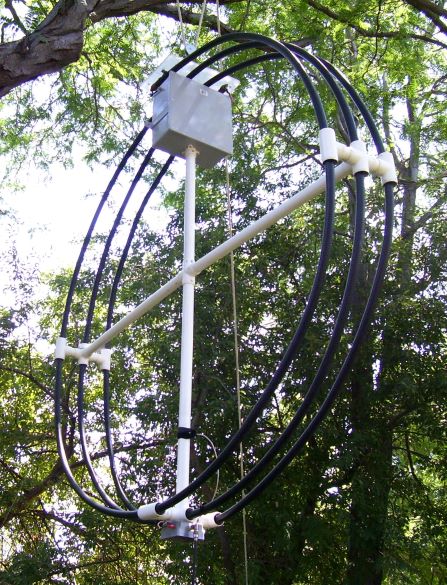
I have used several homebrew small transmitting loop (STL) antennas on 40-160 meters. The two-turn STL is only 4.5 feet in diameter and is used primarily on 40 meters, but it also operates well on 60 and 80 meters. I also designed and built a three-turn STL, six feet in diameter, that covers 80-160 meters. Both STLs use 7/8″ Heliax for the main loop conductor. The coupling loops are located at the electrical half-way point around the loop’s total length (the voltage null) to obtain the best energy transfer and balance.


NOTE: Regarding the 40-80 meter STL, the details of coupling loop size and placement, and other design and construction aspects of the antenna are explained in an article I wrote for the now-defunct antenneX.com on-line antenna magazine back in 2009. At that time most of the articles were behind the “pay wall” and not available to non-subscribers. Now I have the freedom to release the article for general availability. Here’s the Dropbox URL for that article in a PDF file:
https://www.dropbox.com/s/jp735mseqp5lwwz/40-80m_stl.pdf?dl=0
The article shows the coupling loop separated from the main loop by several inches. This position and loop size is not ideal. The picture above shows the loop correctly placed and sized. Additionally, some of the references to vendors of parts are rancid. Small Parts for belt/pulley parts was consumed by Amazon, and their product list has changed. The structural PVC may need to be found elsewhere, too. Do a web search. Fortunately, MGS is still able to provide reasonably priced VVCs, both surplus used and new, although the supply chain issues at times are limiting availability.
The STLcalc program is my effort to produce a freely available program that runs on the major computer platforms, Windows, Linux, and macOS-based systems. STLcalc aids in the design of single-turn (planar) and multi-turn (helical) small transmitting loop (STL) antennas, which have a total loop length of 0.1 Lambda or less for best accuracy. The program allows loop lengths up to about 0.3 Lambda, but the accuracy suffers a bit. Small loop antennas in this wider range are usually called magnetic loop antennas.
The STLcalc program has been updated to version 2.3. The reason for the update is to improve the security of file IO operations by providing an additional check on file identity. Read the UPDATE_NOTE.txt file in the Dropbox download for details on how to use any existing design files.
Here is a list of the recent v2.2 features and behaviors that carry forward to v2.3:
Project Directory – The use of a Project Directory has been added to make organization of files easier than in previous versions. You can create project directories in your file hierarchy for each antenna project. Any file save or read operation, including Export Record actions set the currect project directory. This value is saved at program exit and used at the next program start.
Save/Read File and Export Record – The File->Save, File ->Read, and Export Record actions have been updated to honor the concept of the Project Directory described above.
Help->Display Help – The Help window has been improved for ease of use. It is now scrollable using the mouse wheel as well as the buttons, and the window can be expanded vertically. Material has been added to explain the revised features in detail.
STLcalc has the following appearance on all major platforms, but using the default choices for text and visual effects on each platform. Here are pictures of the Windows main window and the new Loss Resistance dialog. The Linux versions are very similar in appearance to the Windows version. The macOS version has the traditional screen-level menu separate from the application window.


Several “executable” versions of the updated program (v2.x) are currently available in my Dropbox. If a version you need is listed, use the URL to select the one you want, download the ZIPped file, extract the files and/or folder, and follow the instructions in the README file to complete installation. The Windows, Linux, and macOS entries have all been updated to v2.3. NOTE: The macOS version is larger than before. I’m working to get its size down from 20 MB to around the earlier 10-11 MB.
Gus Hansen
KB0YH@arrl.net
My primary focus is on antennas, specifically small transmitting loop
(STL) antennas (a.k.a., magnetic loops), and Log-Periodic Dipole Array
antennas. I have produced free software for each type: STLcalc for the
loops and one for LPDA antennas. You can see samples of my work on my
QRZ.com page.
Where:
In person at 445 S Allison Pkwy, Lakewood, CO 80226, or remote, please go to https://w0tx.org/meet or https://meet.google.com/bsq-zrpv-jpj/, both links go to same place, for our live google meet to chat. Also streaming on https://youtube.com/denverradioclub.
When:
The pre-meeting Elmer session and meeting is scheduled for the third Wednesday of the month at the same time each month. This month 7/16/25, 1800-1845 (local U.S. Mountain Time) for the elmer session, then the Main Program is from 1900 to the end of the meeting.
https://w0tx.org
https://w0tx.org/history
http://www.arrl.org/what-is-ham-radio
https://w0tx.org/discord
No Responses